I'm a software engineer, ex-mathematician, and lifetime learner. This is
my personal webpage, which includes links to things I've done throughout
my entire career, many of which are about my time working on the open
source Git project. Opinions are my own.
-
Investigating Git's architecture as a database, including its data store and synchronization. A compressed version of my Git Merge talk. GitKon, October 2022.
-
Investigating Git's architecture as a database, including its data store, synchronization, and sharding strategies. Git Merge, September 2022.
-
Talking about Git, monorepos, contributing to open source, and being a principal engineer. PodRocket, February 2022.
-
A survey of some advanced Git features to help Git scale to the largest monorepos. GitHub Nova, October 2021.
-
Talking about monorepos and career trajectory. Software Engineering Daily, September 2021.
-
Talking about Git performance features and contributing upstream. Software at Scale, September 2021.
-
How can you make choices in your repository's structure to make it easier to scale? GitHub Universe, December 2020.
-
How can we solve scale for Git? How does Scalar solve this problem? Microsoft European Virtual Open Source Summit, June 2020.
-
How can we solve scale for Git? How does Scalar solve this problem? Git Merge, March 2020.
-
Talking about my career path, contributing to Git and open source. Software Engineering Unlocked, November 2019.
-
A discussion about Git, Git for Windows, and the commit-graph. Thrashing Code, September 2019.
-
An intro to some deep Git concepts, NCSU Software Engineering, August 2019, January 2020.
-
with Johannes Schindelin,
Git Merge 2018.
-
More commands avoid expanding a sparse index when they can operate
directly on sparse directory entries. These integrations improve
performance for git diff-index, patch-mode commands,
git ls-files, and git restore --staged.
Git v2.47.0 through v2.55.0
-
The --path-walk option organizes objects by path before
searching across paths, improving delta compression when Git's name-hash
heuristic has many collisions. It is also available through
git repack and can be enabled for Scalar pushes.
Git v2.51.0
-
The --negotiation-restrict option limits fetch negotiation
to history reachable from selected refs, while
--negotiation-include guarantees that selected tips are sent
as have lines. Per-remote config makes these controls useful
for both fetches and negotiated pushes.
Git v2.55.0
-
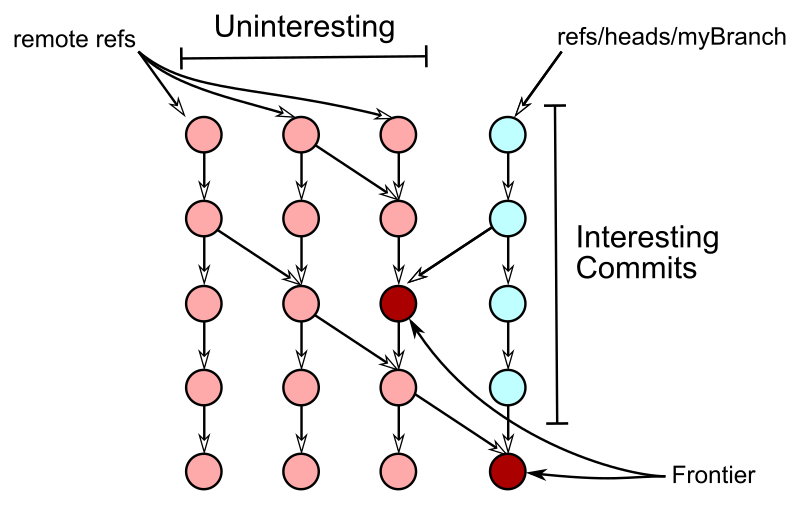
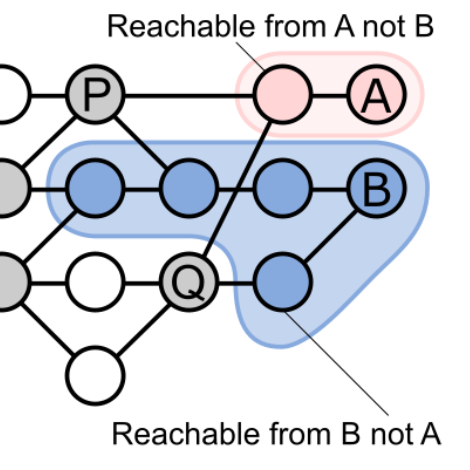
This option restricts revision output to commits that are not reachable
from any other commit in the revision range.
Git v2.54.0
-
The experimental git backfill command bulk-downloads missing
blobs in a blobless partial clone. It groups historical versions by path
into large requests, avoiding many one-blob lazy fetches and enabling
better delta compression.
Git v2.49.0
-
Config listings can now canonicalize each value as a requested type,
such as a boolean, integer, path, expiry date, or color, while omitting
values that do not parse as that type.
Git v2.54.0
-
This new subcommand removes worktree files outside the sparse-checkout
definition so sparse directories can collapse again. Force, dry-run,
and verbose modes protect important files and explain what prevents a
directory from being removed.
Git v2.52.0
-
Scalar users can skip tag downloads when cloning and choose whether
clone, register, and reconfigure operations enable scheduled maintenance.
Background maintenance also tells credential helpers that they are
running non-interactively, preventing helpers from blocking on UI.
Git v2.47.0 and v2.50.0
-
The maintenance.loose-objects.batchSize config option limits
how many loose objects are written into a packfile during each maintenance
run, avoiding oversized background jobs.
Git v2.50.0
-
The --name-hash-version option in
git pack-objects and git repack selects an
alternate path hash that reduces collisions among similarly named files
in different directories, improving delta-base selection and pack size.
Git v2.49.0
-
The git for-each-ref command now understands %(is-base:<committish>)
tokens to discover which of the filtered refs is the likely base of the given commit or branch. A
similar algorithm powers a new Azure DevOps feature for automatically choosing the best target branch
for a new pull request.
-
The git for-each-ref command now understands %(ahead-behind:base)
tokens to output counts for comparing commit histories. This algorithm powers GitHub's
branches page.
-
By enabling this config option, your index writes will speed up
dramatically while only losing a small probability of error detection.
This will speed up `git status`, `git add`, and `git commit` commands,
among others. A version of this feature was previously available in
the `microsoft/git` fork and its version of Scalar.
Git v2.40.0
-
Bundle URIs provide a way to offload object downloads
to static content servers, speeding up clones and fetches
while reducing load on the origin Git server.
Git v2.38.0 (still under development)
-
A new option allowing a stack of topics to automatically have their tracking
topic branches be updated during a rebase.
Git v2.38.0
-
Git's bundle format pairs refs with a pack-file of objects. It can now include
a `filter` capability, allowing a bundle to bootstrap a blobless partial clone.
Git v2.36.0
-
The sparse index reduces the index size when using cone-mode sparse-checkout patterns, creating significant performance boosts for monorepos.
Git v2.32.0, v2.33.0, and v2.34.0
-
A new builtin helps customize Git maintenance. Users can register their repositories to be maintained in the background using git maintenance start.
Git v2.29.0, v2.30.0, v2.31.0
-
A new builtin helps users manage their sparse-checkout files. A new "cone mode" improves performance for a common pattern type.
Git v2.25.0
-
Write the Git commit-graph after every git fetch operation, ensuring that the repo is optimized for the new objects.
Git v2.24.0
-
Create new feature.* config options that group other config options together. Provides recommendations for users who do not want to read every config setting.
Git v2.24.0
-
Speeds up
git commit-graph write by amortizing writes across many small writes (and few big writes).
Git v2.23.0
-
Use the multi-pack-index to repack the object store incrementally in a highly-available environment.
Git v2.23.0
-
Speeds up
git push for developers working in a small cone of a large repo.
Git v2.21.0
-
Significantly speeds up
git log --graph calls when the commit-graph feature is enabled.
Git v2.20.0
-
Verify the multi-pack-index file for corruption.
Git v2.20.0
-
Collect and reorganize commit walking code, and improve several algorithms in the process.
Git v2.20.0
-
Create a new file to index objects across multiple pack-files.
Git v2.20.0
-
Verify the commit-graph file for corruption, and write the file automatically during repo maintenance.
Git v2.20.0
-
Compute generation numbers in the commit-graph file and use them in some commit walks.
Git v2.19.0
-
Create a new data structure and file format to store a compact representation of the commit history.
Git v2.18.0
-
Significantly improve the mechanism for computing the shortest unambiguous abbreviation of an object ID.
Git v2.17.0
-
Features my review of merge-base performance improvements involving
commit-graph generation numbers, paint_down_to_common(),
and ahead_behind() in a 2.6-million-commit monorepo.
-
Explains git rebase --update-refs and demonstrates how
it simplifies updating stacked branches and pull requests.
-
Covers my detailed review of a batch-prefetching series designed to
avoid hundreds of individual blob downloads in partial clones.
-
Discusses my investigation of multi-pack-index version 2 compatibility
and the interaction between fallback behavior and background maintenance.
-
Quotes my explanation of git backfill, its role in
blobless partial clones, its limitations for treeless clones, and
how Scalar configures large repositories.
-
Compares clone-acceleration strategies for large repositories and
contrasts the Git Much Faster script with Scalar.
-
Discusses path-walk packing and cruft-free multi-pack-indexes,
including measurements of repository size improvements.
-
Describes a production deployment of bundle URIs, including the
architecture, configuration, and reduction in clone load.
-
Continues a detailed exploration of stacked branches and rebasing
workflows built around git rebase --update-refs.
-
Provides historical context for Microsoft's migration to Git and
the large-repository performance work that followed.
-
Follows my proposal for a global --no-hooks option and
the discussion that led instead to documenting
core.hooksPath=/dev/null.
-
Features my name-hash version 2 and git backfill work,
including packing measurements from Microsoft's Fluent UI repository.
-
Provides an independent explanation of name-hash version 2 and
git backfill.
-
Investigates bundle URI behavior with a large repository, including
clone benchmarks, protocol details, and limitations.
-
Demonstrates how to use git maintenance in CI to
optimize repositories automatically.
-
Explains the performance problems addressed by
git maintenance and how its maintenance tasks improve
repository performance.
-
Discusses my investigation of Microsoft's 1JS repository and the
path-walk packing improvements that reduced a repacked repository
from 178 GB to approximately 5 GB.
-
Demonstrates the %(is-base:<committish>) token
as a way to infer a branch's likely parent and construct commit ranges.
-
Surveys Microsoft's Git-at-scale work, including VFS for Git, Scalar,
background maintenance, commit-graph, partial clone, sparse-checkout,
and filesystem monitoring.
-
Includes discussions of git for-each-ref's new is-base token and how it can help identify the base branch.
-
Discusses git sparse-checkout command.
-
Discusses the git rebase --update-refs feature in detail and how to use it in your workflow.
-
Includes discussions of scalar in upstream Git as well as the git rebase --update-refs feature.
-
Includes announcement that the sparse index is ready for mainstream use.
-
This blog post from Canva discusses how their monorepo is structured, using features like
feature.manyFiles, background maintenance, and sparse-checkout.
-
Discusses sparse index improvements and partial bundles.
-
Includes updates to the sparse index feature.
-
More sparse index updates, such as `git status`, `git commit`, and `git add`.
-
Announces the sparse index.
-
Includes a description of the git maintenance command and background maintenance.
-
Summarizes some of the Scalar announcement blog post, with additional details from an email interview.
-
Prominently discusses the sparse-checkout feature
-
Features a discussion of the sparse-checkout feature.
-
Features a discussion of feature macros and fetch.writeCommitGraph.
-
Features a discussion of multi-pack-index repack/expire and incremental commit-graph.
-
Features a discussion of the incremental commit-graph feature.
-
I was awarded a Google Open Source Peer Bonus for my contributions to Git.
-
Links to BDFL.
-
Features a discussion of the review around the new sparse push algorithm.
-
Includes description of multi-pack-index feature.
-
John Briggs discusses several Microsoft contributions and how they improve performance for the Windows OS repository. Features commit-graph, multi-pack-index, background prefetch, and sparse push algorithm.
-
Features a summary of the support email thread "commit-graph is cool". Also discusses the RFC on Generation Number v2.
-
Includes an update on the commit-graph feature (in the "Cooking" section).
-
Highlighted in a developer spotlight.